The Great Gatsby Multi-Genre Project
Signer mon livre d'or Faire connaître mon blog Me contacter par mail Flux RSS
Thèmesart article cinema film four love you
RechercherArticles les plus lus· Comic Strip of The Great Gatsby
· Trailer-like Advertissement to Save The Great Gatsby
· Persuasive Letter from a leader of the #SaveGatsby Movement
· Must-See: Great Text Display of The Great Gatsby
· WHAT? Somebody made a collage about The Great Gatsby
· Inspiration Wednesday: A Haiku about The Great Gatsby
· Music Fans: Here's a playlist relevant to The Great Gatsby
Date de création : 10.05.2017
Dernière mise à jour :
10.05.2017
8 articles
Archeologist Finds Artifact about The Great Gatsby
By Pascal Derosby
Proofread by Pierre-Yves Normandin and Eric Tremblay
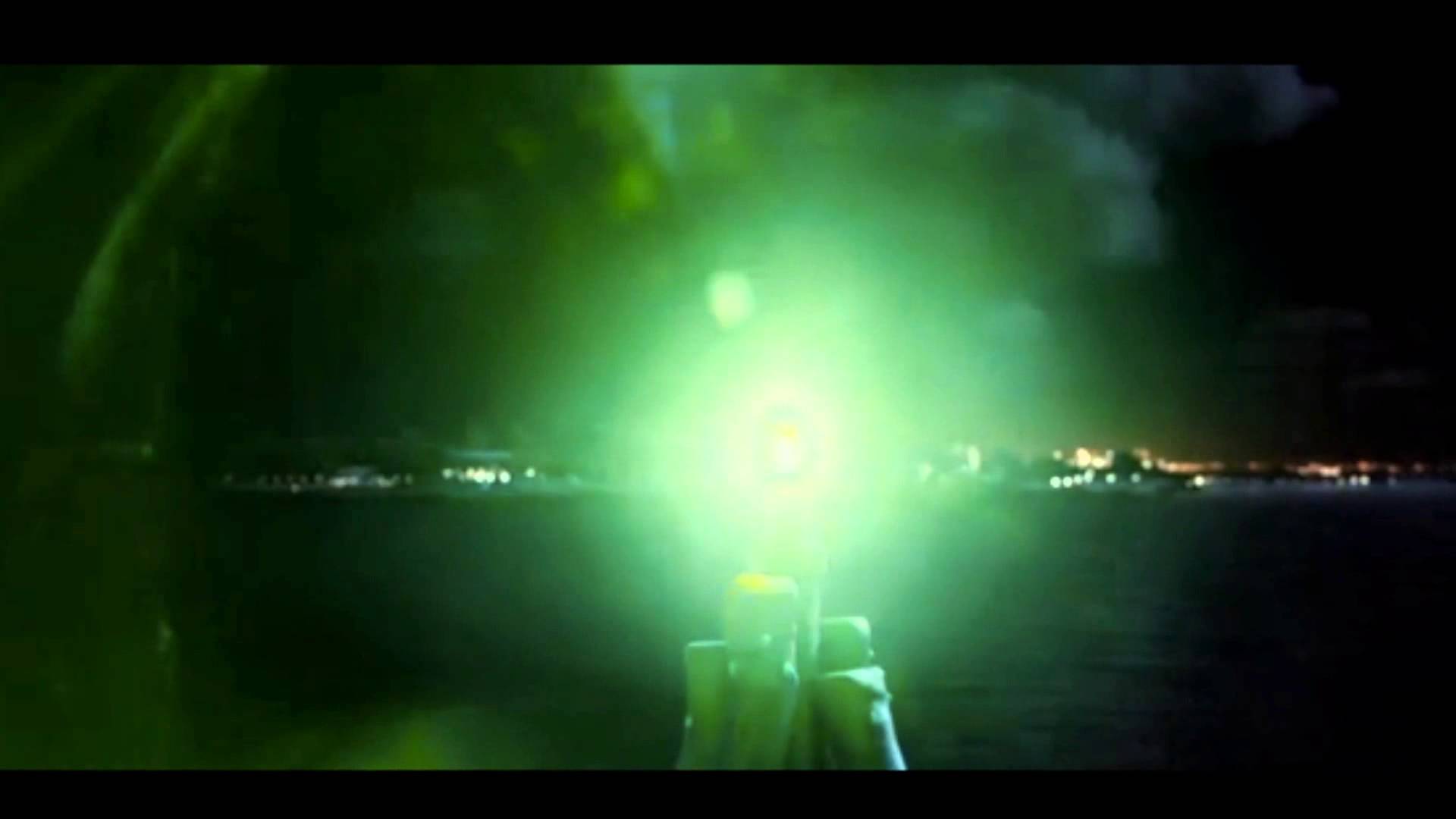
Ysterday, an archeologist found what is believed to be a physical artifact related to The Great Gatsby. While digging behind his yard, he stumbled upon a lamp with green filter on it so that it could give off green light, like the green light referenced in the beginning of the book. Here's the full statemnt given to the media:
"This green light is the most important symbol of the whole book.It might be a simple object, but it ties all the pages together. When this light is seen, it's for the first meeting of Gatsby and Nick for what will be a gret relationship. It's also representative of the dream of Gatsby to get back with Daisy. It's light a green traffic kight telling to go forward with his plan. It also symbolizes the past, and what Gatsby wanted to be.
Music Fans: Here's a playlist relevant to The Great Gatsby

By Eric Tremblay
Verified by Pascal Derosby and Pierre-Yves Normandin
If you like to listen to music while working or have a long car trip coming up, I suggest you give a listen to this playlist with songs relevant to The Great Gatsby. If you want a quick summary of the playlist, here's an analysis of each song and how they relate to the novel.
Link to the playlist: https://www.youtube.com/playlist?list=PLaP1ExS3Ivohw1_g54kFN_DebiLVYfAUd
- Kill our way to heaven by Michl
“We would say anything just to hear what we want
Right or wrong
Then we lie to be forgiven
We would sell anything just to buy who we're not
Any cost
We kill our way to heaven
We kill our way to heaven”
This song, especially its chorus is extremely representative of how the characters from The Great Gatsby are willing to do anything to get what they want. They aren’t afraid to commit crimes and don’t feel a lot of remorse about it. For example, after Daisy killed Myrtle Wilson, Gatsby says: “It’s better that the shock should all come at once,” implying he’s glad Myrtle didn’t suffer, but not sad or anything that she’s dead. Also, we learn near the end that Gatsby’s fortune came from bootlegging. Other characters like Tom and Daisy also show their willingness to do anything to be rich, which is a characteristic of people living on East Egg.
- When I was your man by Bruno Mars
“It all just sounds like oooooh… |
Mmm, too young, too dumb to realize |
That I should've bought you flowers |
And held your hand |
Should've gave you all my hours |
When I had the chance |
Take you to every party |
'Cause all you wanted to do was dance |
Now my baby's dancing |
But she's dancing with another man” |
This song portrays the feelings Gatsby has had for the last decade being away from Daisy. He had to leave her to build some sort of wealth to impress her since he had told her he was a wealthy man because it was what she sought after. Meanwhile, she got married and Gatsby had to live with the feeling of melancholy and regret. The phrase “Take you to every party” is also extremely significant since that’s what Gatsby is trying to get her to come over to his house. He organizes huge parties in the chance that Daisy might one day end up at his home.
- Allentown by Billy Joel
“Well we're waiting here in Allentown |
For the Pennsylvania we never found |
For the promises our teachers gave |
If we worked hard |
If we behaved |
So the graduations hang on the wall |
But they never really helped us at all |
No they never taught us what was real |
Iron and coal |
And chromium steel |
And we're waiting here in Allentown” |
This song is about the lie that is the American Dream. It relates extremely well to the story because of the prominence of the American Dream and the decay of society as themes. The description the narrator does of the desolation in the valley of ashes is a sign that the American Dream did much more harm than good.
- Living in the Past by Jethro Pull
“Let us close our eyes |
Outside their lives go on much faster |
Oh, we won't give in |
We'll keep living in the past” |
Jay Gatsby is a man who’s constantly living in the past. He can’t seem to let go of it. Even when it’s clear that his feelings towards Daisy aren’t entirely reciprocated, he goes out of the way to try and fix things so they’re like they used to be. He too closes his eyes, ignoring the outside life of others and keeps reliving his past
- Hey there Delilah by Plain White T’s
“Hey there, Delilah |
What’s it like in New York City? |
I’m a thousand miles away |
But girl, tonight you look so pretty... Hey there, Delilah I know times are getting hard But just believe me, girl Someday I’ll pay the bills with this guitar” |
This song once again is about how Gatsby has been feeling while he was away from Daisy and how he thinks that now that he’s rich he’ll “pay the bills,” meaning that he can now face Daisy and they’ll be able to live happily together.
- Girls & Boys by Good Charlotte
“Girls don't like boys |
Girls like cars and money |
Boys will laugh at girls when they're not funny” |
This song is about Daisy and how she’s only interested in rich men. In the beginning, she was interested in Gatsby because he was an Oxford student, which is supposed to be prestigious, but it was only the case because of a program for war veterans. She then got married to Tom and stays with him only for the money since she knows he is cheating on her. However, when Gatsby comes back rich, she goes back to him in a heartbeat. Myrtle Wilson is also somebody for whom the shoe fits since she’s taking advantage of Tom’s money so that she can get nice things like a new dog and a seemingly unlimited supply of dresses.
- Creep by TLC
"The 22nd of loneliness and we've |
Been through so many thangs |
I love my man with all honesty |
But I know he's cheatin' on me |
I look him in his eyes but all he |
Tells me is lies to keep me near |
I'll never leave him down though |
I might mess around it's only |
Cause I need some affection oh" |
This song can be linked with the dysfunctional relation between Daisy and her husband Tom. Daisy knows Tom as been cheating on him for a while but Tom keeps trying to make appear as though nothing is going on. In the end, Daisy ends up cheating on him with Gatsby too.
- I Wanna Go Back by Eddie Money
This song is the most interesting one of the bunch since it works on so many levels with different characters. In the first place, this song can be associated to the feeling Nick has by the end of the book wanting to leave the city and go back home in the Midwest where things were much easier. After his break up with Jordan, he “stands alone” again and “feels much older” because he has now entered his thirties. You can also find a completely different meaning or interpretation of the song if you take Gatsby’s perspective. Gatsby wants to go back to when he and Daisy were happy together, “But [he] can’t go back” since Daisy has moved on. He is stuck in the past, but even the past is now unreachable because they’re all older and nothing is exactly the same as before.
"I was listening to the radio |
I heard a song reminded me of long ago |
Back then I thought that things were never gonna change |
It used to be that I never had to feel the pain |
I know that things will never be the same now |
I wanna go back |
And do it all over again |
But I can't go back I know |
I wanna go back |
Cause I'm feeling so much older |
But I can't go back I know |
I recall hanging out on Friday night |
The first slow dance |
Hoping that I'll get it right |
Back then I thought I'd never ever stand alone |
It used to be that a lonely heart was never shown |
I know that things will never be the same |
I wanna go back |
And do it all over again |
But I can't go back I know |
I wanna go back |
Cause I'm feeling so much older |
But I can't go back I know |
Can't go back |
I can't go back |
I know now that things will never be the same |
I said |
I wanna go back |
And do it all over again |
But I can't go back I know |
I wanna go back |
Cause I'm feeling so much older |
But I can't go back I know |
I wanna go back |
And do it all over again |
But I can't go back I know |
I wanna go back |
Cause I'm feeling so much older |
But I can't go back I know |
I wanna go back |
And do it all over again |
But I can't go back I know |
I wanna go back |
Cause I'm feeling so much older |
But I can't go back I know |
No, No |
And do it all over…" |
Inspiration Wednesday: A Haiku about The Great Gatsby

By Pierre-Yves Normandin
Proofread by Eric Tremblay and Pascal Derosby
For this edition of "Inspiration Wednesday" we would like to present to you this haiku about The Great Gatsby. For the uninitiated, a haiku is a small poem of only three phrases. However, these phrases must have a specific amount of syllables. The first phrase must have 5 syllables, the second 7 syllables and the last one 5 syllables.
Wealth and its hope
Drowning with despair and their
Past long-forgotten.
With only a few words, the author of this haiku is able to represent the morality of the novel. It touches a lot of themes and symbolisms of this classic book. Here is what the author had to say about his creation
"In this haiku, ‘’wealth’’ is obviously symbolizing Gatsby, and ‘’its hope’’ represents his desire to regain what he had lost, that is to say, his past with Daisy.
The word ‘’drowning’’ recalls Gatsby’s death - although he did not literally drowned – and it symbolizes the way Gatsby put all his faith in winning back is love, Daisy, and failed. As Nick says in the novel, maybe he no longer cared about getting back what he had lost, but I think he was nevertheless destroyed.
I also think that Mr. Wilson lived quite the same situation than Gatsby, but apparently he reacted differently. Nothing else was left in the world for Wilson – Myrtle was all he had – and he knew it. That is why he decided to end his days and to make someone pay for it. I thought ‘’despair’’ was the perfect word to represent what was left of the man.
Finally, we could say that both men lived while taking Daisy and Myrtle for granted. They believed they could recreate the happiness they knew in the past. However, it was a ‘’past long gone’’: Myrtle and Daisy were Tom’s for a long time."
WHAT? Somebody made a collage about The Great Gatsby

By Pierre-Yves Normandin
Verified by Pascal Derosby and Eric Tremblay
Our younger generation's creativity might not be completely doomed. This collage made by a young litterature fan about the classic The Great Gatsby is simply outstanding. He sent us this letter in which he gave us his interpretation of his work of art:
"How many novels adapted five times to cinema do you know? Yet, The Great Gatsby is one of them - even if one of these was not really a success, but it is still remarkable. That is why I represented in this collage the two most successful representations of this fantastic novel.
The main thing I wanted to represent in this poster is the incredible resemblances between them – even if they were separated by almost thirty years - and with the novel. The choice of actors is one of the most obvious similarities.
Most of the main scenes are displayed: Gatsby’s mansion and Nick’s cottage in West Egg; Tom Buchanan’s house in East Egg; Wilson’s garage in the valley of ashes; and Myrtle’s apartment in Washington heights.
I think the most amazing aspect of these movies is the set – Gatsby’s house is exactly as I imagined (particularly in the 2013 version). We could see that they put everything in the visual aspect of the movies (in either version): it is bright, colorful and extravagant as Gatsby’s universe."
Must-See: Great Text Display of The Great Gatsby

By Eric Tremblay
Proofread by Pascal Derosby and Pierre-Yves Normandin
Text Display of The Great Gatsby Explanation
The text display represents two eggs. The one on the left represents West Egg, the place where Gatsby and Nick live, where the “new money” is. It’s the place where young rich people who made their own fortune live in New York City. The right egg represents East Egg, home to Daisy and Tom Buchannan and where the “old money” resides. It’s where more conservative people reside. The people living in East Egg usually received their fortunes through their family members. The contrast between the mentalities of both Eggs in the story is represented by the colors and the font used to write the quotes. West Egg contains the young people who party all night at Gatsby’s home and in the display, it is represented as a colourful to relate with the brashness and the “in your face” of the West Egg. Meanwhile, East Egg is much less flashy than its Western counterpart. The other difference between both eggs in the display is the content of the eggs. The quotes all represent at last one strong aspect of the novel whether it’s the characters, the themes, the conflicts and the messages. In the West Egg, it contains the quotes related to the conflicts and the flamboyant personalities, which is something that is easily associable with West egg. As for East Eggs, it has the quotes related to the deeper meaning of the story and the theme, something much more subtle than the big heteroclite homes of West Egg.
Persuasive Letter from a leader of the #SaveGatsby Movement

By Pascal Derosby,
Proofread by Pierre-Yves Normandin and Eric Tremblay
A student currently trying to save the novel The Great Gatsby from the governmental cuts in the 103 course wrote an open letter to the prime minister of the province of Quebec. Here is the letter in its integrality:
May 3rd
Pascal Derosby
Quebec education’s Committee,
All three of us are student in the 103 (English culture and literature) class and one of your announcement bothers us. Indeed, you announced some weeks ago that you were going to remove the novel we read in class, The Great Gatsby, from the class’s course. Aware of the academic value of this novel and its importance for the students all across Quebec, we write you this letter to discuss this matter.
"First of all, the purpose of this course is learning to analyse literary works in depths, to fully understand the story and the role each part plays in it. Be it the theme, characters, symbols, dialogues and more, they all hold a great importance. The great Gatsby, with its countless themes and symbols, as well as not plentiful but really detailed characters, perfectly suits this purpose. The vocabulary in it also plays a great part in its substantiality. As 103 students, we are expected to have a high level in English and this novel, through a large amount of old, as well as new, expressions and a very rich vocabulary, forces the students to go out of their comfort zone and research those terms, so that they don’t hinder their comprehension of the story.
According to us, watching the movie adaptation would be a great idea, to support the reader’s reading and confirm some shadowy details that text can’t explicitly demonstrate. They could also see the character’s behavior in action and then deepen this aspect in their analysis. Another good idea would be to include some other theme’s related works. The book “The Rules of Civility” would be the perfect example to relate to, as it is considered by its reader as the “modern Great Gatsby”. Making connections between those two books would support the student’s analysis and his knowledge about the themes found in the two of them.
We hope that our suggestions demonstrate how important The Great Gatsby’s place in this 103 course is and will weigh enough to tip the scales. If you have any questions, you can contact our teacher anytime, she’ll pass them on to us."
Here's hoping his powerful argumentation will lead to some actions by the government of Quebec.
Trailer-like Advertissement to Save The Great Gatsby

By Eric Tremblay
Verified by Pascal Derosby and Pierre-Yves Normandin
https://www.youtube.com/watch?v=GZStozZRJB4
Because of the recent proposal of the Quebec Education Comitee, a group of filmmaker put together an advertissement to speak up against the proposal and try to save their favorite novel, The Great Gatsby. Here's what they had to say about it:
-"We were outraged when we learned that The Great Gatsby was part of the books in danger of being teken off the 103 English Program. We decided to create our own campaign and made an "ad" to get people to talk about the situation. We tried to show a bit of the mystery that surronds the character of Gatsby to get people interested. Also, it was our objective to convey the emotions felt when the reader has this book in hand. Obviously, we included some iconic dialogues like Gatsby's famous "Old sport" to play on the classic/famous aspect of the book. In the end, our main goal was to get people to talk about The Great Gatsby and make people interested in reading it. We think we made a good job in showing that it's not just an ordinary love story. The story is extremely unorthodox and there are some deeper meanings than just love."
Comic Strip of The Great Gatsby

By Pierre-Yves Normandin
Proofread by Eric Tremblay and Pascal Derosby
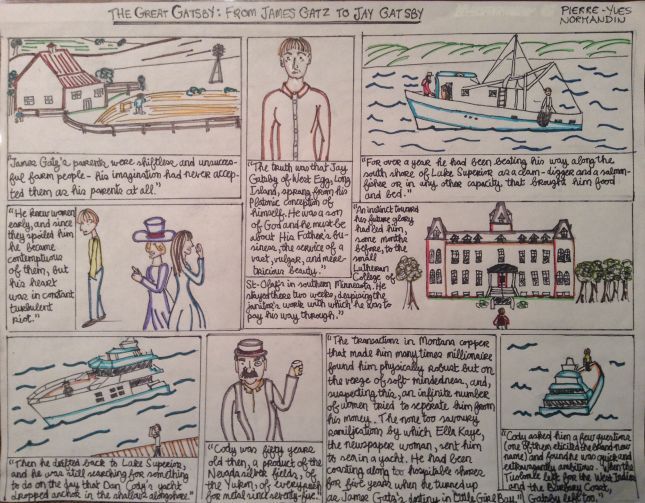
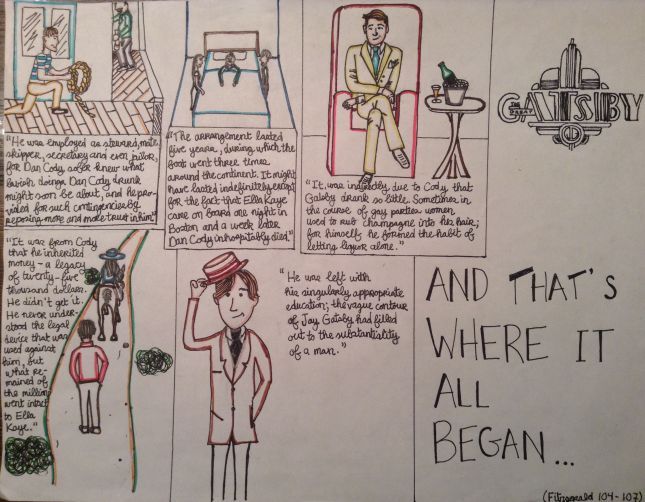
The first ever article of our blog is about this magnificient comic strip made in honor of The Great Gatsby. It might seem like a simplification of the story, but it actually has a lot of deep thought put into it to convey the plot and the atmosphere although simplistically. The artist behind all of it wrote a great article about how he was able to make a rationalization of the comic strip. Have a look:
"I chose to illustrate a part of Gatsby’s past - from his childhood to the beginning of his adulthood - because I think it is a capital one in the story (even if it only lasts three or four pages). I also think that many psychological traits of Gatsby and his attitude are specified in those pages and those explain some of Gatsby’s actions.
First, I illustrated a part of Gatsby’s early childhood and the loneliness he felt there, while he was thinking that he did not belong there, that he did not accepted his parents and that he was, in some way, ‘’a son of God’’. All these elements determined one characteristic of Gatsby: he is somewhat snob. I mean his parents raised him their best and loved him – as we can see in the end when his father comes to his funeral – and “The Great Gatsby” still feel ashamed of them.
The second thing I felt important to illustrate was the difficulties he experienced in his path to wealth and greatness. As it is written in the novel, “he had [to] beat his way along the south shore of Lake Superior as a clam-digger and a salmon fisher…” (Fitzgerald 104), until Dan Cody gave him his chance, and from that we can only say that he is really a hard-worker and a persistent person.
Also, as Dan Cody noticed from Gatsby as he hired him, he was already “quick and extravagantly ambitious” (Fitzgerald 105), and it is the reason of his later success. Effectively, even if Gatsby’s business were not totally “legal”, he had to have a vision and ambition to be successful and to gain notoriety.
Finally, Dan Cody was a very important character in Gatsby’s development: as he later says to Nick “[Cody] used to be [his] best friend years ago.” (Fitzgerald 99) Even if he didn’t give young Gatz any money, he gave him something far more valuable: ‘’a singularly appropriate education’’. He taught him how to behave like a rich man and indirectly, to avoid alcohol. Gatsby also learnt to beware of crooks like Ella Kaye, who took all the inheritance of Cody for herself."